General Counsel and the New Era of AI Oversight
In July we asked whether the General Counsel seat is becoming a launchpad to the CEO role. In August we looked at pay and an expanding remit, in September at influence with the board, and in October at general counsel joining Law Firm partnerships. One theme has run through all four: AI. This month, James Franklin looks at why general counsel AI oversight is moving to the center of the role.
In just two years, AI has gone from experiment to everyday tool for in-house legal teams. The Association of Corporate Counsel’s September 2026 survey of 576 in-house lawyers worldwide found that 85% of legal departments now use AI, up from 23% in 2024.
“85% of legal departments now use AI, up from 23% in 2024.” Association of Corporate Counsel, September 2026
Regulators are now catching up. On November 4, 2026, the Office of the Comptroller of the Currency (OCC) issued a supervisory framework for examiners evaluating how banks use AI. Federal agencies now refer to AI as “super intelligence,” or SI, following a September 29 Executive Order. The OCC is clear that the framework is a resource for examiners, not a set of new requirements. Even so, PwC described it as the clearest indication yet of the questions examiners are likely to ask.
For general counsel at US banks and other regulated institutions, those questions sound very familiar.
Why AI Oversight Lands on the General Counsel’s Desk
The framework is organized around six pillars: purpose and permitted use, risk classification, controls and safeguards, governance and human oversight, operational resilience, and testing and assurance. Much of it reads like a legal brief. Banks are expected to document what each system is authorized to do. They should establish clear accountability, manage third-party risk and maintain independent challenge. They should also keep records sufficient to reconstruct material system actions and decisions.
The framework also makes a point about people. Human oversight is only effective if reviewers have the expertise, authority and capacity to act. That is a governance design question, and increasingly a legal one.
It also fills a gap. In April, the banking agencies’ revised model risk management guidance excluded generative and agentic AI from its scope. That left banks to decide on appropriate controls through their wider governance. In practice, general counsel are often the people best placed to make that wider governance hold together.
Legal Uses AI, but Rarely Decides on It
Most legal departments now use AI. The same ACC survey shows that decision rights have not followed.
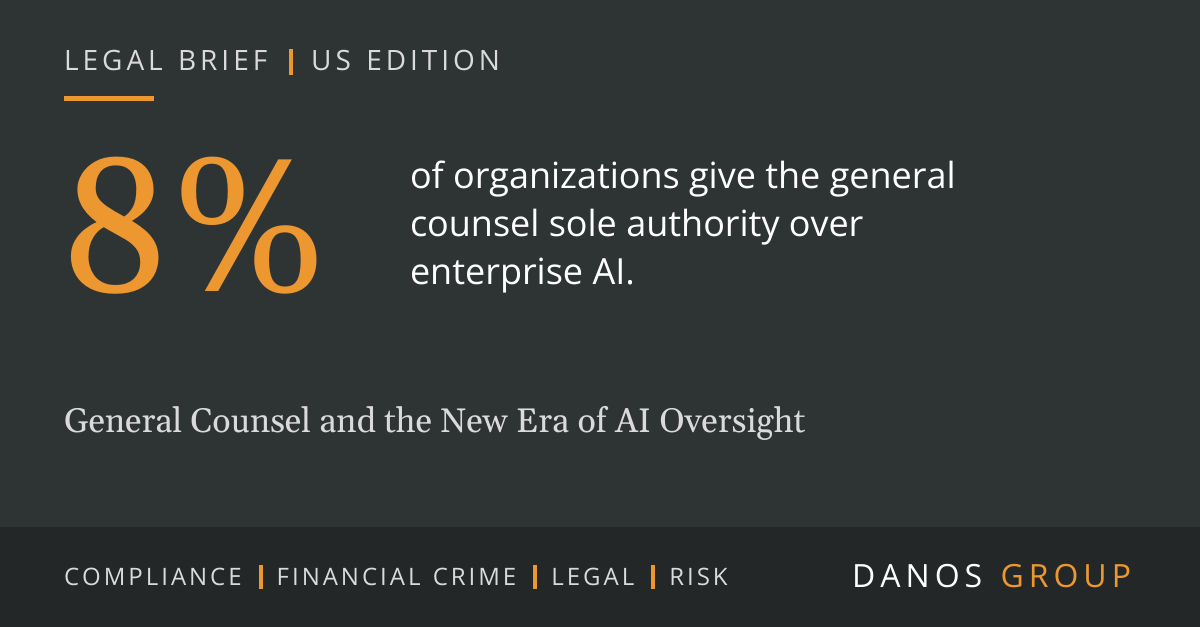
73% of organizations place final AI approval outside the legal department, most often with IT leadership. Just 8% give the general counsel sole authority to approve enterprise AI tools. 41% of legal departments have never audited for unauthorized, or “shadow,” AI use, and 39% do not formally track AI return on investment.
This is not about legal taking AI away from technology teams. It is about legal judgment being built into how systems are approved, contracted and monitored from the start. Legal leaders see it too. In Diligent’s 2026 study of 309 general counsel, corporate secretaries and senior in-house lawyers, 64% named AI governance and oversight as the most critical skill for the next three years.
What This Means for Hiring
“Almost every GC search we’ve run this year has had an AI question in it. Boards and CEOs aren’t asking whether a candidate is comfortable with AI. They’re asking whether that person could sit across from an examiner and explain how the institution governs it. That’s a different skill, it’s in short supply, and in the Financial Services searches we run it’s increasingly what separates the shortlist from the hire.” James Franklin, Managing Director, Head of Legal, Danos Group
The shift reaches beyond the GC seat. PwC’s commentary on the OCC framework flags workforce risks the framework only partly addresses. These include gaps in AI fluency, dependence on key people and contractors, and whether staffing levels support meaningful human oversight. For HR leaders, that puts AI governance squarely into role design and workforce planning. Deputy general counsel and senior counsel who combine bank regulatory experience with technology contracts, data privacy and third-party risk are increasingly in demand.
What This Means for Law Firms
For Law Firm partners advising Financial Services clients, AI oversight is fast becoming a core advisory need. Clients want help with vendor contracts, accountability mapping, examiner readiness and documentation. As we saw in October, former general counsel who have handled these issues from the inside are a valuable hire for firms building that capability.
For lawyers considering a move in-house, hands-on AI experience is now a clear differentiator. Advising on an AI vendor agreement or a regulatory response is exactly the evidence in-house hiring panels look for.
For Boards, CEOs and HR Leaders
- Decide where legal sits in AI approval, and set it out in the GC role specification and offer.
- Give oversight roles real authority and capacity. The OCC framework is explicit that oversight depends on both.
- When hiring, ask for evidence: a use case the candidate governed, a vendor agreement they negotiated, an incident they managed.
For GCs, Heads of Legal and Lawyers Moving In-House From a Law Firm
- Map your material AI systems, their owners and their contracts, starting with third-party systems.
- Test whether you could reconstruct a material AI decision for an examiner today.
- Ask to join AI decisions at the design stage, not at sign-off.
The Takeaway on General Counsel AI Oversight
In September we described AI as the clearest example of where general counsel can lead. The OCC’s framework now spells out the questions that leadership has to answer. Institutions have the tools. What they need is someone who can make oversight work in practice, across contracts, accountability and regulatory expectations. In US Financial Services, that person is increasingly the general counsel.
If this is a conversation your board or leadership team should be having, we would welcome the chance to talk. Please contact James Franklin at jfranklin@thedanosgroup.com.
Sources: OCC Bulletin 2026-54 and supervisory framework (November 2026); PwC, Our Take: OCC AI supervision (November 13, 2026); Association of Corporate Counsel, The In-house Legal AI Landscape (September 2026); Diligent, Global State of Legal Entity Compliance 2026.