
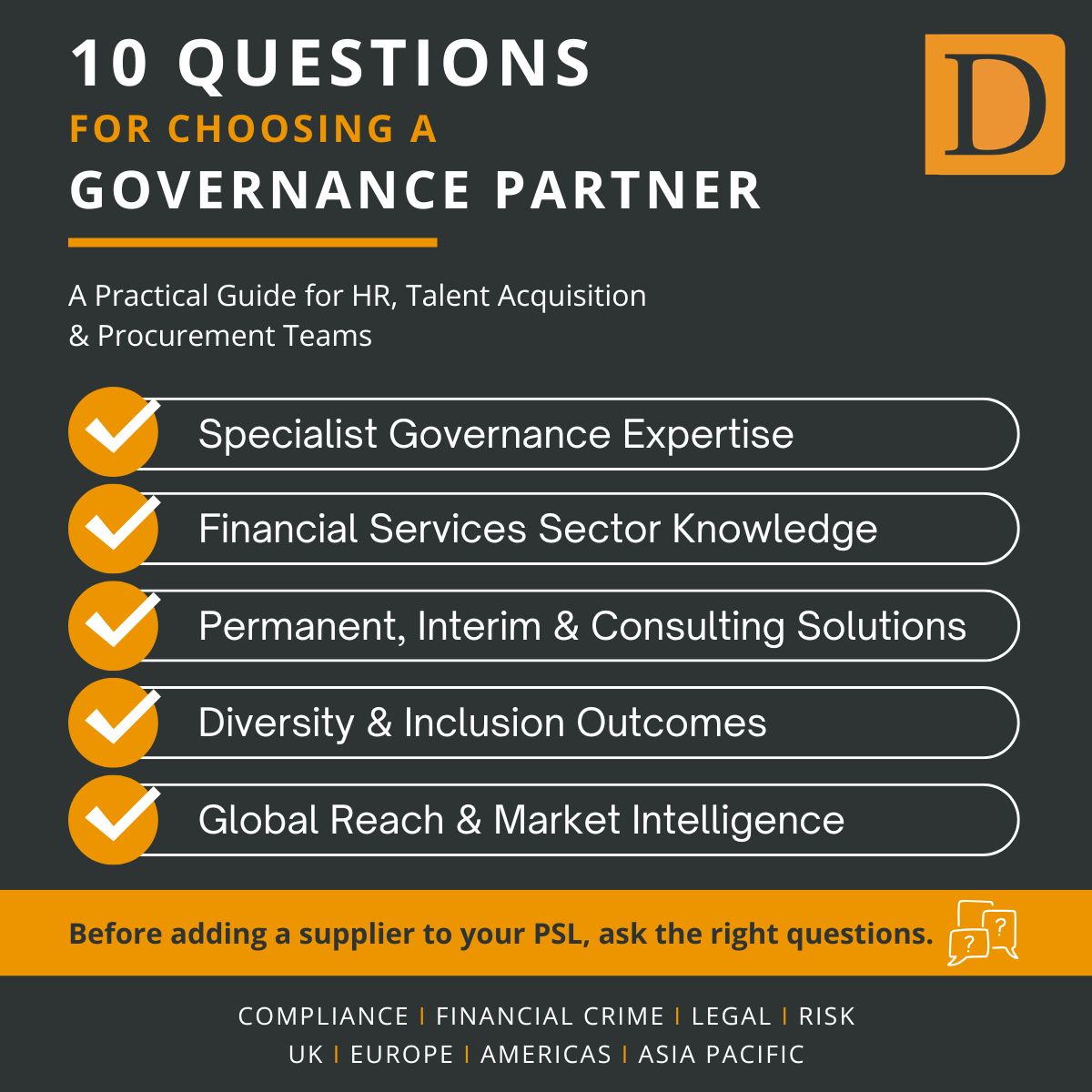
10 Questions for Choosing a Governance Partner
Selecting the right governance recruitment partner can significantly impact hiring outcomes, diversity objectives, stakeholder satisfaction and long-term business performance. There are the 10 questions every HR and Talent Acquisition team should ask before appointing a supplier.
Financial Services organisations invest significant time and resources selecting recruitment partners. Yet many vendor reviews focus on commercial terms, service levels and contract requirements without fully assessing whether a supplier can successfully deliver specialist governance talent.
Governance recruitment is a highly specialised area covering Compliance, Financial Crime, Legal, Risk, Operational Resilience and broader control functions. These roles often sit at the heart of an organisation’s regulatory framework and can have a direct impact on business performance, regulatory outcomes and organisational reputation.
For HR, Talent Acquisition and Procurement teams reviewing their preferred supplier list (PSL) or appointing new recruitment partners, the following questions can help identify suppliers capable of delivering long-term value.
What Does Governance Recruitment Cover?
Before assessing a supplier, it is important to understand the breadth of governance hiring.
Governance recruitment typically includes permanent, interim and consulting requirements across:
| Compliance: Chief Compliance Officer (CCO), Head of Compliance, Compliance Director, Compliance Advisory, Compliance Monitoring, Compliance Testing, Regulatory Compliance Manager, Consumer Duty Specialist, Conduct Risk Specialist. | Financial Crime: Head of Financial Crime, MLRO, Deputy MLRO, Financial Crime Director, AML Manager, AML Analyst, KYC Analyst, Client Onboarding Specialist, Transaction Monitoring Analyst, Sanctions Specialist, Financial Crime Investigations, Market Surveillance Specialists, Fraud Risk Professionals. |
| Legal: General Counsel, Deputy General Counsel, Head of Legal, Legal Counsel, Senior Legal Counsel, Regulatory Lawyer, Banking Lawyer, Funds Lawyer, Company Secretary, Governance Counsel. | Risk: Chief Risk Officer (CRO), Head of Risk, Enterprise Risk Manager, Operational Risk Manager, Credit Risk Manager, Market Risk Manager, Model Risk Specialist, Quantitative Risk Analyst, Risk Analytics Director. |
Interim & Consulting Solutions
Many organisations also require specialist consultants and interim professionals to support:
- Regulatory Remediation Programmes
- Financial Crime Transformation
- Consumer Duty Projects
- Compliance Monitoring Reviews
- AML and KYC Remediation
- Operational Resilience Programmes
- Skilled Person Reviews
- Governance Framework Enhancements
- Risk Transformation Initiatives
- Project-Based Regulatory Change
The breadth of these disciplines highlights why specialist expertise is so important when selecting a governance recruitment partner.
1. Do They Specialise in Governance Hiring and Understand Your Sector?
Many recruitment firms claim expertise across Compliance, Legal, Risk and Financial Crime. However, governance hiring requires more than functional knowledge. It demands specialist market expertise, established networks and a detailed understanding of the regulatory and commercial challenges facing different areas of Financial Services.
A governance professional who has built their career within a global investment bank may not necessarily be the right fit for a hedge fund, insurer, payment institution or cryptocurrency business. Understanding these differences is critical when identifying and assessing talent.
Ask prospective suppliers:
- How long have they specialised in governance recruitment?
- What percentage of their business comes from governance functions?
- Can they demonstrate expertise across both the functions and sectors relevant to your organisation?
A specialist partner should be able to discuss market trends, talent availability and regulatory developments with confidence, whilst demonstrating expertise across the sectors they support.
This may include Investment Banking, Asset Management, Hedge Funds, Private Equity, Wealth Management, Insurance, FinTech, Payments, Digital Assets and broader Consulting and Advisory businesses. The strongest partners combine functional expertise with sector knowledge, enabling them to identify candidates who possess both the technical capabilities and commercial experience required to succeed within your organisation.
2. Can They Support Permanent, Interim and Consulting Requirements?
Hiring needs often change quickly.
A firm may begin with a permanent search but later require interim cover, project consultants or a fully outsourced remediation team.
Working with a partner capable of delivering permanent recruitment, interim solutions and consulting services can reduce supplier management complexity whilst providing greater flexibility during periods of change.
3. What Percentage of Their Business Comes From Repeat Clients?
Repeat business is one of the strongest indicators of supplier performance.
A high level of repeat business suggests the supplier consistently delivers quality candidates, strong service and positive hiring outcomes.
Ask potential partners how much of their revenue comes from existing client relationships and whether they can demonstrate long-term partnerships.
4. How Large and Relevant Is Their Network?
Database size alone is rarely a useful measure.
The more important question is whether a supplier has access to relevant active and passive talent within your specific market.
For example, sourcing a Deputy MLRO within a global investment bank requires a very different network and market understanding from sourcing the same role within a hedge fund, insurer, payment institution or cryptocurrency business.
Strong governance recruitment partners should be able to demonstrate depth across multiple seniority levels and specialist disciplines.
5. Can They Demonstrate Diversity Outcomes?
Diversity and inclusion remain a key priority for many organisations.
Rather than relying on broad statements, ask suppliers for evidence of how they support diversity within hiring processes.
Questions may include:
- How do they source diverse talent?
- How do they reduce bias within search processes?
- Can they provide diversity-related hiring metrics?
The strongest partners will be able to demonstrate measurable outcomes rather than simply discussing intentions.
6. How Do They Assess Candidate Quality?
Successful recruitment goes beyond matching a CV to a job description.
A robust assessment process should evaluate:
- Technical capability
- Regulatory knowledge
- Leadership experience
- Cultural alignment
- Career motivations
- Long-term suitability
Understanding how a supplier qualifies candidates can provide valuable insight into the quality of talent likely to be presented.
7. Do They Provide Market Intelligence?
The best recruitment partners provide more than candidates.
They should also provide insight into:
- Compensation trends
- Hiring activity
- Talent availability
- Market sentiment
- Regulatory developments
- Competitor activity
This information can help organisations make more informed workforce planning decisions.
8. Can They Support International Hiring?
Many governance functions operate across multiple jurisdictions.
When evaluating a supplier, consider:
- Geographic coverage
- Local market expertise
- International search capability
- Knowledge of regional regulatory environments
A partner with international reach can support both local hiring requirements and broader global talent strategies.
9. How Do They Measure Candidate and Client Satisfaction?
A supplier’s service quality should be measurable.
Ask whether they collect:
- Client feedback
- Candidate feedback
- Net Promoter Scores (NPS)
- Testimonials
- Service reviews
Suppliers that actively measure satisfaction often demonstrate a stronger commitment to continuous improvement.
10. Do They Act as a Strategic Partner or Simply Supply CVs?
Perhaps the most important question is whether a supplier acts as a trusted advisor.
Strong recruitment partners challenge assumptions, provide market intelligence, offer strategic hiring advice and help organisations navigate changing market conditions.
They invest time in understanding organisational culture, long-term business objectives and future workforce requirements.
Ultimately, the most successful recruitment relationships are partnerships rather than transactions.
Explore Our Specialist Expertise
Governance recruitment spans multiple disciplines, sectors and regions.
Our team includes specialists across Compliance, Financial Crime, Legal, Risk and Governance Consulting, supporting clients throughout the UK, Europe, the Americas and Asia Pacific across investment banking, asset management, hedge funds, private equity, insurance, fintech, payments and digital assets.
To learn more about our functional, sector and regional expertise, visit our team directory: Meet the Danos Group Team
Final Thoughts
Selecting a governance recruitment partner is an important decision for any Financial Services organisation.
The right supplier should offer specialist expertise, access to high-quality talent, measurable outcomes, market intelligence and the flexibility to support permanent, interim and consulting requirements.
By asking the questions outlined above, HR, Talent Acquisition and Procurement teams can make more informed supplier decisions and build stronger governance functions for the future.
At Danos Group, these are the same questions we encourage prospective clients to ask when evaluating any governance talent partner. We believe informed decisions create stronger partnerships and ultimately deliver better hiring outcomes.


