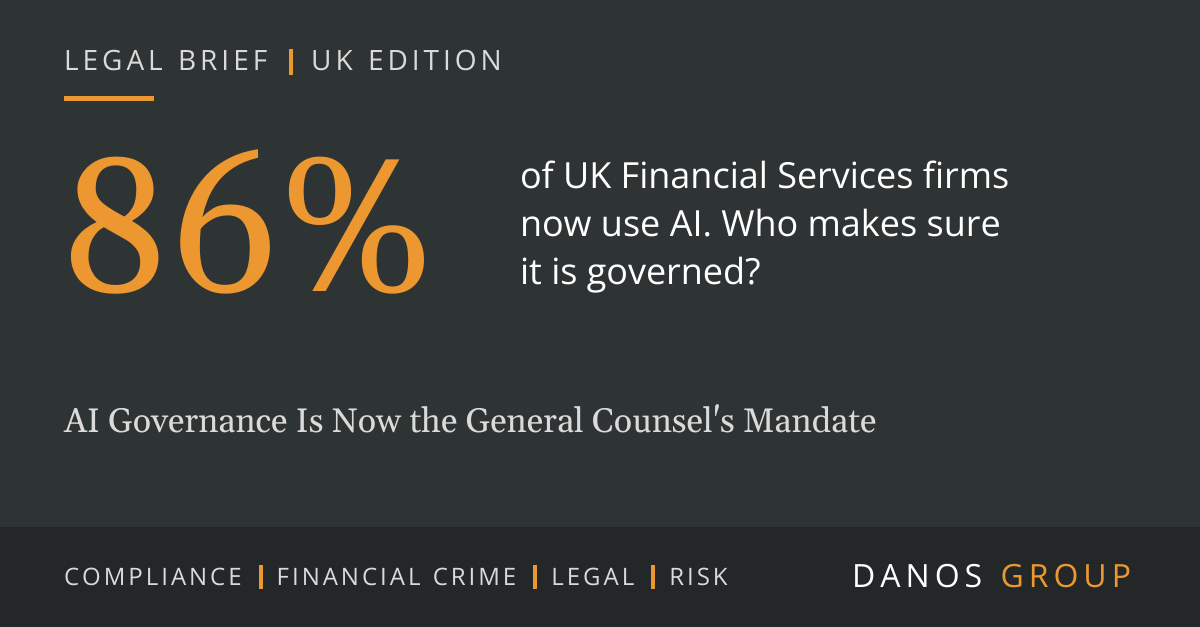
AI Governance Is Now the General Counsel’s Mandate
In July we asked whether the General Counsel seat is becoming a launchpad to the CEO role. In August we looked at how far the remit has grown, in September at boardroom influence, and in October at GCs moving into Private Practice. One theme has run through all four: AI. This month, James Franklin looks at why AI governance for General Counsel has become a core part of the job.
In just two years, AI has gone from experiment to everyday tool for in-house legal teams. The Association of Corporate Counsel’s September 2026 survey of 576 in-house lawyers worldwide found that 85% of legal departments now use AI, up from 23% in 2024.
“85% of legal departments now use AI, up from 23% in 2024.” Association of Corporate Counsel, September 2026
UK Financial Services firms are moving just as fast. The Bank of England and FCA published their fourth AI survey on 26 October 2026, covering 196 firms. It found that 86% of respondents now use AI, up from 75% in 2024. Eight in ten have AI agents deployed, and a further 14% plan to deploy them within a year.
Most firms have the paperwork in place. 94% report firm-wide AI policies, principles or standards. The harder question is who makes sure that governance holds up once a system is live. Increasingly, that is a legal question.
Why AI Governance Needs General Counsel
The survey shows where the gaps sit. Controls before deployment are strong: human approval, pre-deployment review and vendor due diligence were each reported by more than 90% of firms. Controls after deployment are thinner. Ongoing monitoring and periodic review were each reported by only around half, and fewer than half have incident response playbooks.
Third-party AI is where legal judgement matters most. Third-party systems now make up 53% of high-materiality AI systems, up from 35% in 2024. For those systems, 81% of firms rely on vendor assurance and contractual arrangements to understand them. Only 24% say they have deep knowledge of how they work. Negotiating contractual protections, such as liability, audit rights, data use and notice of changes, was the second most cited challenge in adopting third-party AI.
That is home ground for a General Counsel. So is accountability. Asked who is accountable for AI systems and their outputs, firms named business owners (94%), executive leadership (90%), the board (64%) and compliance (63%). Legal does not appear among the nine roles the survey lists. That is less a criticism than an opportunity.
What the FCA Expects
On 19 October 2026, the FCA published examples of good practice and areas for improvement in firms’ use of AI. It is not proposing new rules. It expects firms to apply the existing framework, across three themes: the Consumer Duty, governance and accountability, and operational and cyber resilience.
Some of its findings will be familiar to any GC. Some firms had deployed AI before putting clear governance in place, leaving no route to escalate or challenge decisions when risks emerged. Others relied on vendor assurances without testing them, even though firms remain accountable for AI they outsource. In one case, a firm had to redesign its product when the AI model it depended on was retired.
The FCA also expects senior managers to take reasonable steps to understand and mitigate AI risks in their areas. Under the Senior Managers and Certification Regime (SM&CR), that is personal accountability. The FCA’s Phase 2 consultation (CP26/37) would reduce the regime’s administrative burden. Commentators are clear, however, that the focus on individual accountability remains.
Legal Uses AI, but Rarely Decides on It
Most legal teams now use AI, yet they rarely decide how it is used. The same ACC survey found that 73% of organisations place final AI approval outside legal, most often with IT. Just 8% give the General Counsel sole authority to approve enterprise AI tools. And 41% of legal departments have never audited for unauthorised, or “shadow”, AI use.
This is not about legal taking AI away from technology teams. It is about legal judgement being built in at the design stage, which is exactly where the FCA says governance belongs. Legal leaders know it. In Diligent’s 2026 study of 309 general counsel, company secretaries and senior in-house lawyers, 64% named AI governance and oversight as the most critical skill for the next three years.
What This Means for Hiring
“Eighteen months ago, AI came up at the end of a GC interview, if at all. Now it is one of the first things a board asks about. They don’t want to hear about a policy. They want to know whether a candidate has actually governed AI in a regulated firm: negotiated the vendor contract, mapped who is accountable, handled something going wrong. Very few people can show all three yet, and the ones who can are moving to the top of shortlists.” James Franklin, Managing Director, Head of Legal, Danos Group
The same shift is reaching the rest of the legal team. Deputies, Heads of Legal and senior counsel who combine regulatory knowledge with technology contracts, data protection and operational resilience experience are increasingly valued. As we wrote in August, the remit is growing faster than the resourcing. AI governance needs to be part of the headcount and workforce planning conversation, not an addition to an existing job description.
What This Means for Private Practice
For Law Firm partners advising Financial Services clients, AI governance is fast becoming a core advisory need. Clients want help with vendor contracts, accountability mapping, Consumer Duty testing and FCA engagement. As we saw in October, former GCs who have governed these issues from the inside are a valuable hire for firms building that capability.
For lawyers considering a move in-house, hands-on AI experience is now a clear differentiator. Advising on an AI vendor contract or a regulatory response is exactly the evidence in-house hiring panels look for.
For Boards, Chairs and HR Leaders
- Decide where legal sits in AI approval, and set it out in the GC role specification and offer.
- Resource the role to match the remit. AI governance should come with budget and headcount, not just a title.
- When hiring, ask for evidence: a use case the candidate governed, a vendor contract they negotiated, an incident they managed.
For GCs, Heads of Legal and Lawyers Moving In-House From Private Practice
- Map your material AI systems, their owners and their contracts, starting with high-materiality third-party systems.
- Ask to join AI decisions at the design stage, not at sign-off.
- Give the board a short, regular view of which systems are material, who is accountable and how they are monitored.
The Takeaway: AI Governance for General Counsel
In September we described AI as the clearest example of where General Counsel can lead. The evidence now shows how. Firms have the policies. What they need is someone who can make governance work in practice, across contracts, accountability and regulatory expectations. In UK Financial Services, that person is increasingly the General Counsel.
If this is a conversation your board or leadership team should be having, we would welcome the chance to talk. Please contact James Franklin at jfranklin@thedanosgroup.com.
Sources: Bank of England and FCA, Artificial intelligence in UK financial services 2026; FCA, AI in financial services (October 2026); FCA CP26/37; Association of Corporate Counsel, The In-house Legal AI Landscape (September 2026); Diligent, Global State of Legal Entity Compliance 2026.